
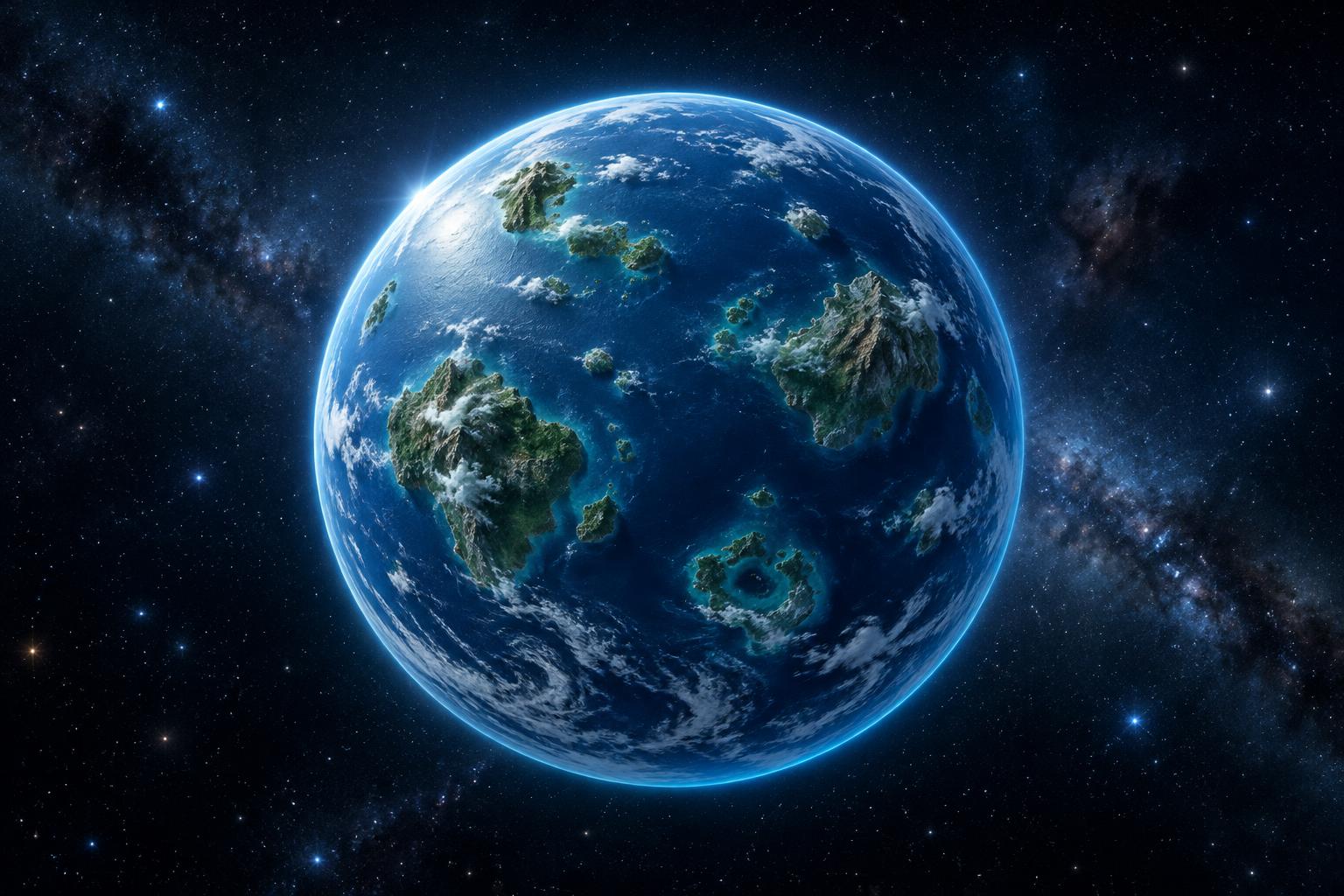
In the first part, we came to know the world on which we live within this tale, and the circumstances that drove groups of humans to leave their planets and search for a new home, until they reached the planet of the water sphere. We spoke of their different environments and features, of beginning their lives again, and then of the encounters that brought them together after long periods of isolation. Yet something else remained worth pausing over: language.
If the newcomers had lived on different planets, and each group had its own civilisation and way of life, it is natural, in our story's conception, that each should have its own language understood by its people. They brought words, sounds and ways of expressing themselves, just as they carried their memories and whatever knowledge they had been able to retain. When they landed in distant regions, language became part of what linked each group to its past, even as the details of that past were lost with passing generations.
Here we ask: could some words inherited by the water sphere's inhabitants, within our tale, be remnants of names for places no longer present in their memory? Did the names of stars, seas and directions mean something to the first arrivals different from what they came to mean to their children? We hear a word and know how to use it, but may not know everything it passed through before reaching us. Through this door, language becomes another thread we follow in searching for the story of arrival.
Let us now return to the question of distant lands left open in the first part. We imagined stretches of the water sphere that the inhabitants of our known fictional world had not reached, and spoke of accounts their groups passed along about lands behind an ice wall. If we suppose that humans live in those regions, would they have a language of their own? What would their lives be like? Did they lose their ancestors' technology as the others did, or manage to preserve and develop it?
We can imagine a group that arrived at a different time, or landed somewhere that allowed it to preserve its equipment and knowledge. Its members might share certain features, or stand out for their height, perhaps with hair colours unfamiliar to us, such as grey or blue. These are details we sketch for the inhabitants of that imagined region; their way of living and what they know of the rest of the world remain questions waiting for events to reveal them.
But the greatest surprise may not lie in their appearance, but in the way they understand one another.
We are used to hearing another person to understand their speech, reading what they write, or following their gestures and facial expressions. But what if these people had another means? What if two people stood facing one another and exchanged a complete conversation without either tongue moving, and without us hearing a single sound? An observer might think them silent, while questions, answers and feelings passed between them that the observer could not perceive.
Here we approach the idea to which we open a door through The Silent Language. In this story's conception, those inhabitants can send meaning and feeling from one person to another through a mental connection, without relying on the spoken words we know. Perhaps this ability is the fruit of technology they preserved, or a means they learned and developed over their long history. Its nature and limits are what we will leave the tale to reveal later.
To approach the question, we can look at some of what humans are researching today in our known world. There are experiments with interfaces connecting the brain to a computer, using implanted electrodes and artificial intelligence systems to decode patterns of neural activity associated with attempted speech, and even imagined speech in some experiments, and turn them into words. This is real research aimed at helping people who have lost the ability to communicate. It depends on devices, training and computer processing, and differs from direct natural telepathy between two people.[1]
From here our imagination stretches one step further: what if these attempts, advanced to us, were merely an early beginning in those inhabitants' history? What if they had long ago moved beyond the need for visible devices, and their way of connecting had become something familiar their children learned, just as our children learn to speak? The chip we see as a major achievement might, in their eyes, resemble a tool they once knew and then no longer needed. This is the possibility we give a place within the story's world.
Meeting them would then become more complicated than we imagined. We might search for sounds and letters to learn their language, while they send something we do not know how to receive. We might stand close to them without understanding that a conversation is taking place at all. Perhaps the first question at the meeting would not be, “What is your language?” but rather, “How can we hear what you do not utter aloud?”
In the sequence of this tale, we suppose that secret contact has already occurred between some inhabitants of those regions and people from the known world, while its details remained far from everyone else. Another question appears: what passed between them? Did they exchange knowledge? Did that contact influence some of what developed within the story's world? We will leave this thread open, without revealing now who began the contact, why it remained secret, or what each side wanted from the other.
Thus we return beyond the distances we can see. In our imagined world, communities may live on the same water sphere, separated from us by regions we have not crossed and means of communication we have not understood. Some of those we seek among the stars may be closer than the story's characters imagine, while the true newcomer from afar is still on the way.
But what of the mysterious signals discussed in the accounts within our story? Do they come from another planet, or from a distant place on the water sphere? Are we searching for words within them while they carry meaning in a different way? Perhaps some of those signals are misunderstood natural phenomena, requiring those who follow them to distinguish between what they hope to find and what their observations actually reveal.
From here, the question “Are we alone?” opens more than one path before us. It may take our characters into space, return them to unknown regions of their world, or lead them to reconsider the meaning of language itself. Is it enough to possess the ability to send a message, or must there also be someone who knows how to receive and understand it?
The tale began with humanity's journey to a new home, then brought us to a different kind of journey: searching for a way to understand those we have not yet met. Between the language we hear and the language we imagine crossing through silence, a question remains for the next part: What if the message has already arrived, but we have not yet learned how to read it?
End of part two.