
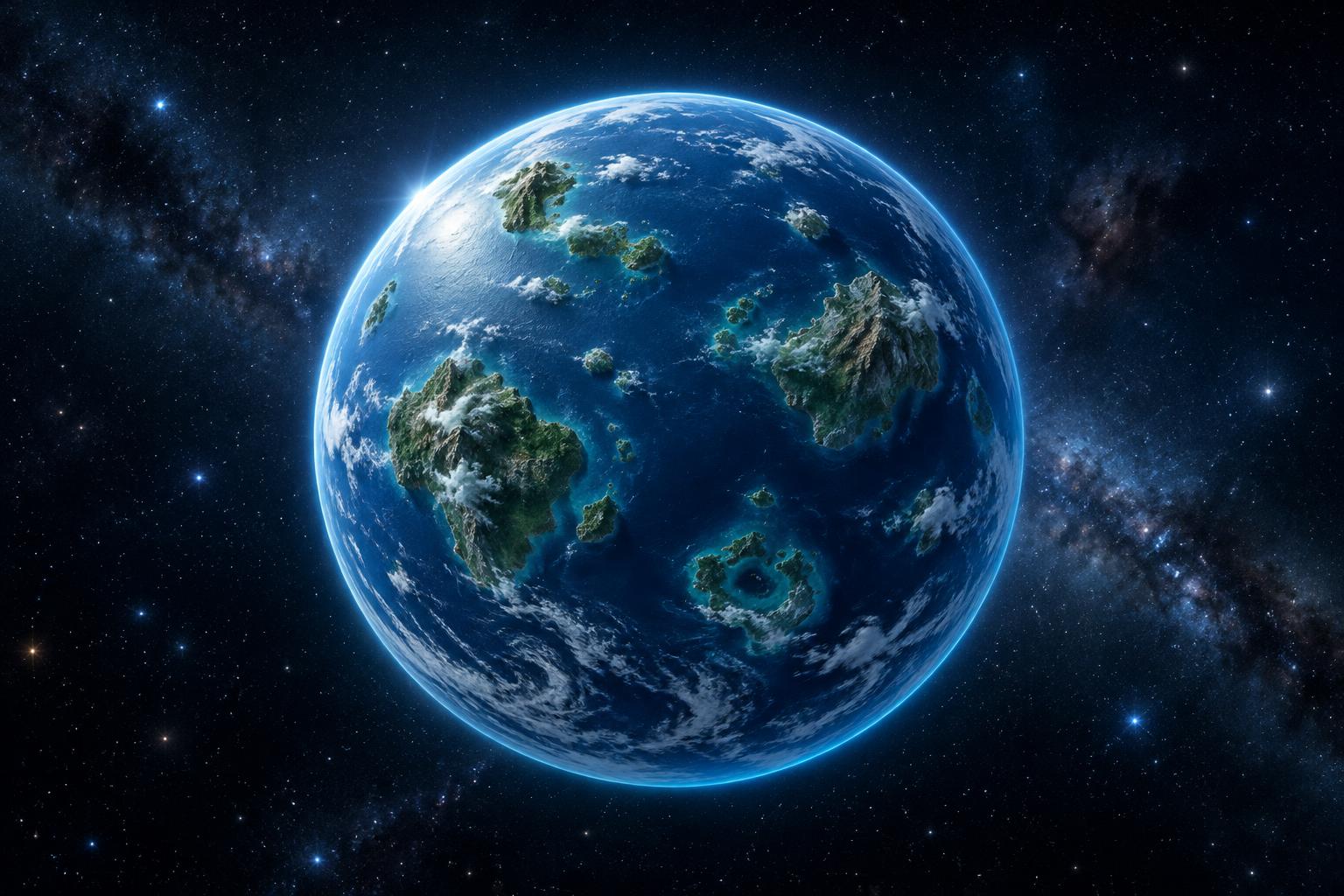
Where did humans come from before arriving on Earth? What is their story? And why do skin colours, facial features and physical characteristics differ from one group to another? We see these differences every day, and have grown so accustomed to them that we often pass over them without pausing for long. But what if we opened another door to these questions in our imagination, and began thinking beyond the frame through which we have become used to viewing our story?
Let us begin in a very distant age, when immense cosmic explosions scattered matter and dust through space. There were gaseous, liquid and solid materials, dispersing and gathering across vast distances. In the world of this tale, among them was an enormous drop of cosmic water, far larger than anything we imagine when we hear the word “drop.” It was a vast water sphere, moving through that space and carrying on its surface whatever dust and scattered matter reached it.
As time passed, some of that dust began collecting on the water sphere's surface, mixing with the water to form muddy deposits. Over millions of years, these deposits accumulated, bound together and hardened until they became broad stretches of land floating upon the water. Thus began the formation of the Earth to which humans would later arrive, unaware of everything that water sphere concealed, or how far its lands extended.
But before humans reached this place, where had they lived?
In our story, they inhabited other planets, each with its own orbit, environment, terrain and conditions for life. Those conditions had made the inhabitants of each planet resemble one another in many characteristics, especially skin colour, facial features and physique. Each world had its people, its cultures and its way of living. The differences between these groups were part of the history of their emergence in widely separated homelands.
Those societies possessed remarkably advanced technology. They had extensive knowledge of physics and chemistry, and industries and capabilities humans have not attained in their present lives. They could control many of their living conditions and build means of transport that crossed the boundaries of their planets. Yet all that progress did not prevent them from facing a danger greater than they could contain.
A group of those planets had been affected by tremendous cosmic explosions, and their inhabitants realised that remaining where they were might end in their destruction. They hurried to build large vessels capable of carrying groups of people away to other regions of the universe, perhaps to galaxies far from the danger. People qualified for these journeys were selected, carrying whatever knowledge, expertise and necessities for survival they could, in the hope of finding somewhere a new life could begin.
The vessels left their homelands. Behind each lay a world its passengers knew; ahead lay space in which they did not know where their journey would end. As the effects of the catastrophe diminished in the regions they passed through, the search began for a planet suitable for habitation. They travelled among different worlds, but what they found did not suit their lives. Whenever the conditions for survival were not met, they had to continue their journey with whatever resources remained.
Until some of those groups reached the water sphere.
The newcomers found broad lands that, according to our tale, had formed from deposits accumulated above the water. Conditions there had become suitable for living: water, oxygen they could breathe, soil that could support crops, and microscopic life that had helped, over time, prepare an environment where plants and trees could grow. After a long journey among places that would not let them remain, this world seemed an opportunity they could not afford to lose.
Groups of humans landed in different regions separated by immense distances. Not everyone arrived under the same conditions, nor did they retain equal amounts of equipment and resources. Over time, tools broke, materials ran out, and means they could not replace were lost. Knowing how to manufacture a device is not enough to build it; tools, materials, energy sources and industries that support one another are also needed. Thus the technology they had brought began to decline, and they had to start again with what their new environment allowed.
Humans began relying on the land and farming, learning how to provide food, build homes and preserve their lives. Survival came first. As generations succeeded one another, much of what the first arrivals had known changed, and memories were scattered between what survived in stories and what vanished with those who held them. Each human community came to live within its own boundaries, preserving its features, customs and whatever it could pass on to its children.
Communication between these communities was not easy. Distances were great, transport was limited, and the technology that had brought them was no longer available as before. People began by walking, then enlisted animals and developed ways to travel farther. Across successive ages, they built their tools and recovered some of their capacity for innovation, until reaching other groups became possible.
When the meeting came, caution was present. Each group found before it people who resembled them in some ways and differed in others: features, skin colours, languages, customs and ways of living. Dialogue began, and agreements and rules were established to help dealings between them and preserve each group's distinctiveness. As contact increased, some people moved from one land to another, intermarriage occurred, and new relationships and communities emerged. There were periods of peace in which humans learned that cooperation opened possibilities they could not reach alone.
But that peace did not always endure. Greed, covetousness and the desire for control emerged, and disputes began over land, water, wealth and influence. Some disputes turned into wars. Many people died, and knowledge and experience were lost with them; places that might have become foundations for a better life were damaged. After periods of conflict, people returned to understanding, set boundaries and agreements to share resources and organise their lives, then began again to rebuild what had been destroyed and develop what they possessed.
And so the story continued between closeness and separation, cooperation and conflict, and progress sometimes followed by decline. Eventually humans reached stages familiar from our history, including the world wars and wars that continue to recur. Here the question with which we began returns within this story: did anything remain of the memory of that first arrival? And did the differences between the newcomers carry stories older than everything their generations had preserved on this world?
To continue, we must return to the place itself: the water sphere.
In this tale's conception, the sphere appears round to someone able to look at it from afar, while the land extending over its surface seems flat to someone living on a small portion of it, though it curves across that vast surface. The view can therefore differ with the observer's position and the distance from which they look. But the question we wish to open here concerns what the sphere's inhabitants know about the limits of their world: have they reached all its lands, or do spaces remain in the story's world where their feet have never stepped?
Other accounts begin with this question. Reports arrive of an ice wall, of lands beyond it, and of places the newcomers have been unable to reach. Do other humans live there? Did groups reach more distant regions and remain isolated from the rest of the inhabitants? Or are the stories people pass along simply tales changed by repeated telling? Within this series, those accounts will become questions that drive events forward, and those pursuing them will seek what supports them or reveals their errors.
Then a more distant question appears: what if the journey of arrival is not yet over? What if vessels remain on their way to this world, or communities are still searching for a place to receive them? Could new arrivals come bearing knowledge like that the first settlers lost? Would humans recognise them, or confront them with the same fear with which the groups faced one another at their meeting?
Here the name “Atlas” appears on the horizon of the tale, awakening new questions. Does this name refer only to a phenomenon people watch from afar, or is it connected to an event that will change what they know of their past? Will it have a link to the first arrivals, or take the story in a direction no one expected?
We will not answer all of that now. What we have reached is the beginning of a series in which we will continue searching within our imagined world, following its events and the secrets its characters uncover. The water sphere has become humanity's home, but the story of their arrival, what they left behind, and what may be on its way to them still waits to be told.
End of part one.