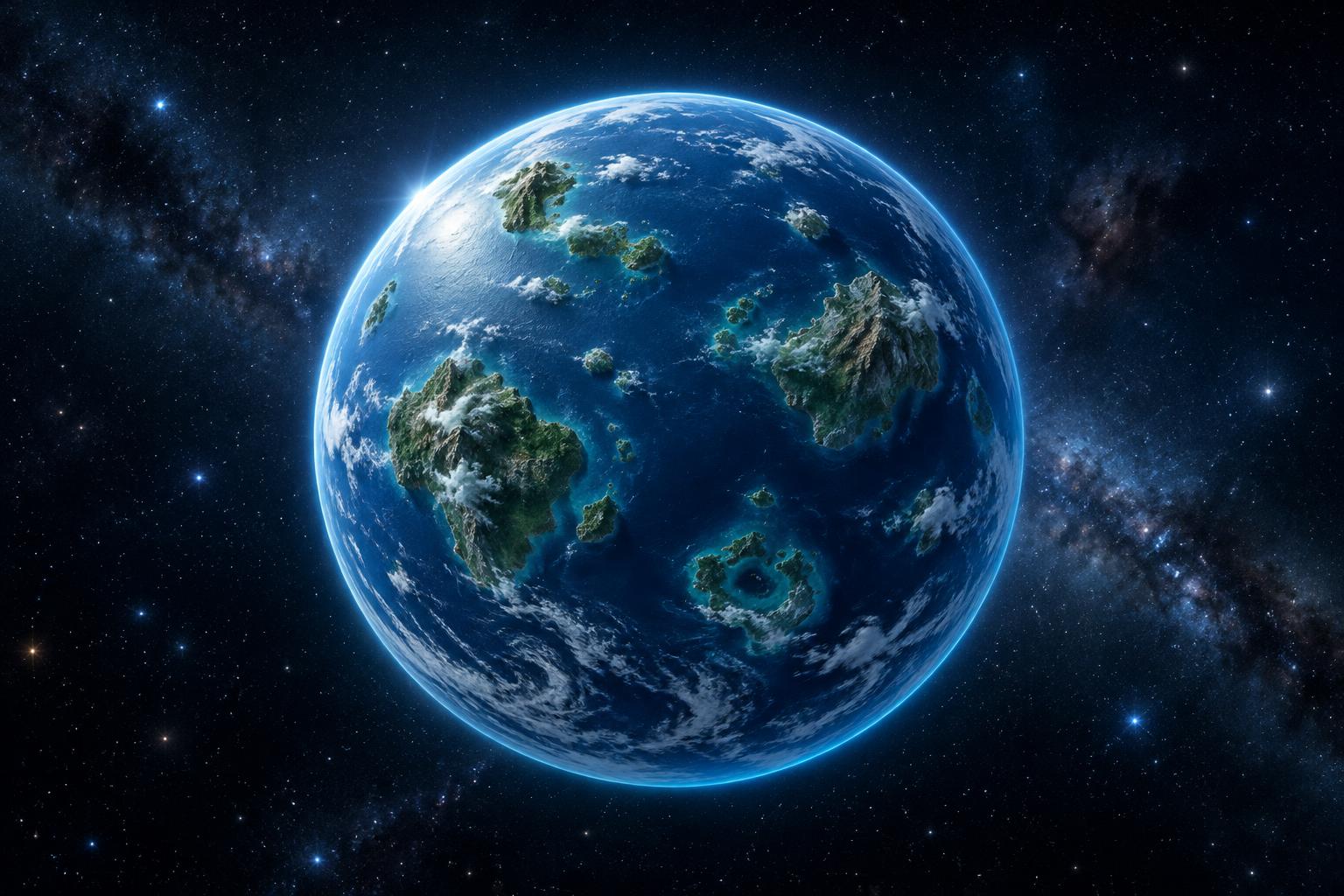
Debate has long raged between those who believe Earth is spherical and those who imagine it flat. But what if both theories were wrong? What if we imagined Earth as an immense water sphere drifting through the cosmos, gathering cosmic dust over millions of years until land formed and life began?
A journey of science fiction and philosophical reflection; not an established scientific explanation of Earth's formation or shape.
The mother sea
In the world of this story, there were no continents at first, only a blue sea that shone beneath the stars. Sailors called it the mother sea and imagined a sphere of ionic water: simply water containing dissolved charged particles, neither a magical substance nor a source of supernatural powers. The survival and stability of this world are assumptions of the fiction, not a description of our real planet. Each evening, a researcher named Nour walked down to the pier and watched the sky reflected below. If water carries our cities, she wondered, what do we carry in our memory of it? No answer came, but she began recording questions instead of burying them.
From dust to land
The memory of this imagined world tells of cosmic dust falling onto the sea for ages. Under laws invented for the story, it gathered into floating plates that became islands. This is not offered as a scientific mechanism for the formation of land. On one plate grew a forest, then a village, then a city that forgot it was afloat. Nour found differently coloured layers in the rocks and read them like pages whose author she did not know. During the storm season, the island shifted a little, changing the stars above the harbour. Its people realised their maps had not lied; they described a moment that had passed. Charting a route became a continuing act, not an eternal promise.
Lands beyond the mist
Beyond familiar routes lay a belt of mist that never cleared. In this story alone, ancient barriers sustained it, separating lands inhabited by other civilisations; this is not a claim about hidden boundaries on the real Earth. Nour did not know who had built the barriers, or whether they served protection or isolation. She sailed with a small team, carrying supplies, observation equipment and messages of welcome. Beyond the veil, lights moved in a steady rhythm, like a breathing city. They raised no flag of ownership and did not announce that they understood everything. They stopped their engines and waited for permission to approach. Their first discovery was the limit of their knowledge, not the limit of the sea.
The first signal
On the third night, an instrument caught a sequence of pulses. Nour separated repetition from noise and found a pattern resembling a drawing in an old manuscript from her city's archive. The manuscript, message and civilisation are all invented elements of this tale, not archaeological evidence or historical events. After several attempts, a simple question appeared on the screen: ‘Can you hear us?’ Contact was no miracle, but advanced technology within the fictional world, using light, encoding and translation. Nour sent a short answer, then left room for silence. The reply did not reveal the secret of the universe; it offered a meeting at dawn. Sometimes knowledge begins with a greeting, not a declaration that we possess the truth.
An open question
The ship returned with an invitation, not treasure. The city disagreed about what to do: some wanted exclusive control of the route, while others wanted to publish everything immediately. Nour suggested first asking what responsibility they owed those they had met, and distinguishing observation from interpretation, dreams from evidence. Knowledge may enlarge our world, but it does not give its holder the right to control it. She placed a new map beside a window overlooking the sea and left its edges open. The story had not changed the facts about Earth, only the way of looking at the unknown: curiosity accompanied by humility, discovery followed by care. Below the city, the water kept moving, and the final question remained literary, not a test of our planet's shape.
Are we living upon land… or upon water?